Commercial Waste Waterloo: Creating an Eco-Friendly Waste Disposal Area
Commercial Waste Waterloo is committed to building an eco-friendly waste disposal area and a sustainable rubbish area that supports local businesses, protects the River Thames corridor and advances the circular economy. Our approach to Waterloo commercial waste emphasises practical recycling programs, clear operational targets and partnerships across the boroughs. We design city-centre systems that reduce landfill, lower carbon emissions and help businesses comply with local regulations.
Ambitious Recycling Targets and Borough Collaboration
We have set a clear recycling percentage target: 70% recycling and diversion from landfill by 2030 for commercial collections in the Waterloo area. This goal is aligned with wider municipal strategies across nearby boroughs such as Lambeth and Southwark, which have adopted progressive approaches to waste separation. Those boroughs encourage pre-sorted streams for paper, cardboard, mixed recyclables, food waste and glass, and we work with local tenants and property managers to integrate these routines into commercial premises. By harmonising containers and signage we reduce contamination and improve capture rates in the commercial recycling Waterloo landscape.
Designing a Sustainable Rubbish Area for Businesses
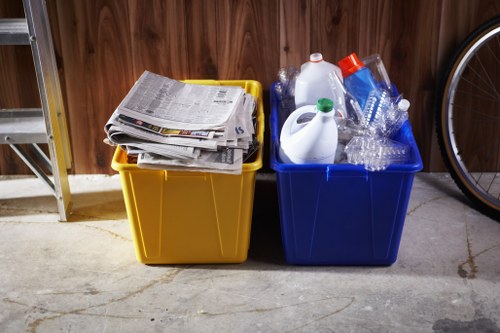
Our designs for a sustainable rubbish area include dedicated bays for segregated collections, on-site compaction where appropriate and covered storage to avoid litter and vermin issues. The Waterloo sustainable waste management model encourages businesses to minimise residual waste through procurement choices, separation at source and participation in reuse schemes. We promote clear, consistent labelling and staff training so that cardboard, plastics and organics are kept clean and dry — essential for achieving the recycling percentage target we publicly report on.
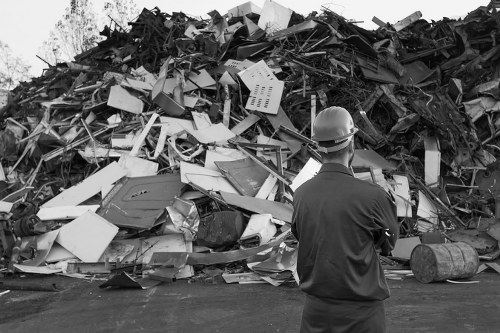 To facilitate practical operations, we map local transfer stations and civic amenity points that handle commercial waste streams. Examples include transfer facilities serving central London where material is consolidated before onward recycling or energy recovery. Our network allows smaller businesses to access the economies of scale they need to divert more material away from landfill, while reducing street-level collections and idling time for vehicles.
Local transfer stations and consolidation hubs are essential in the chain from premises to processor. Typical facilities we work with include municipal transfer stations accepting segregated food waste, glass banks and paper baling areas, plus private consolidation sites for dry mixed recyclables. These transfer points accelerate the route to high-quality recycling and support the local economy by keeping material streams clean and traceable.
Key elements of our operational plan include:
- Scheduled consolidation to reduce vehicle miles and idling
- Pre-sorting at source to lower contamination and improve market value
- Transparent reporting against our recycling percentage target and carbon reduction goals
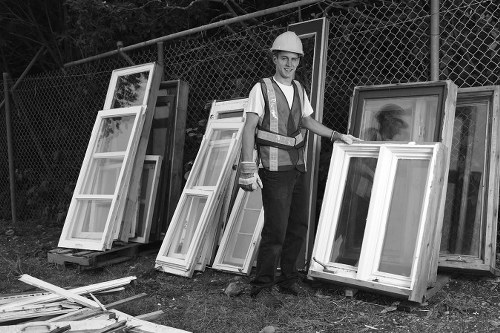
We also prioritise partnerships with charities and social enterprises to give items a second life. Through collaborations with local not-for-profits, surplus furniture, textiles and packaged but unused consumables can be diverted away from the waste stream, supporting community projects and reducing the need for raw materials.
Our charity partnerships are purposefully practical: we arrange regular collections for usable office furniture and electronic equipment with qualified refurbishment charities, and coordinate food donation routes for edible surplus. These relationships turn a traditional waste cost into a community benefit while lowering the carbon footprint of disposal. Examples of activity include scheduled charity pick-ups from mixed-use developments, direct handovers for social projects and integration with circular procurement programmes.
Low-Carbon Fleet and Operational Efficiency
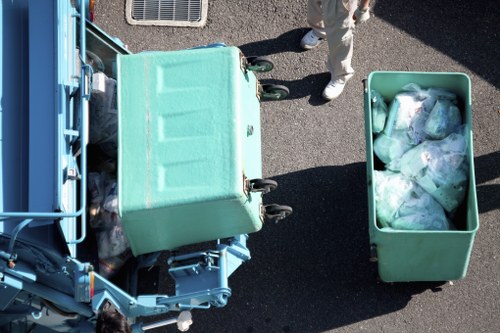
Fleet decarbonisation is central to creating an eco-friendly waste disposal area. Our commercial collection fleet includes low-carbon vans and electric vehicles, complemented by hybrid lift trucks and cargo bikes for last-mile servicing where streets are narrow. By transitioning to low-carbon vans and optimising routes with telematics and dynamic scheduling, we reduce emissions and noise in the Waterloo area while improving collection reliability.
Monitoring, Reporting and Continuous Improvement
We publish periodic reports showing progress toward the recycling percentage target, including tonnes diverted, contamination rates and vehicle emissions saved through low-carbon vans. Continuous improvement cycles use data from transfer stations, customer feedback and borough-level policy updates to refine container mixes, collection frequencies and education campaigns. This data-led approach ensures our sustainable rubbish area proposals remain practical and aligned with local waste plans.
Our commitment extends beyond collection: we support reuse markets, work with processors who adhere to strict quality standards and promote circular procurement among commercial clients. By combining ambitious targets, meaningful charity partnerships, an electric and low-emission fleet, and close coordination with local borough waste separation policies, Commercial Waste Waterloo is building a resilient, low-impact model for commercial waste in the heart of the city.
We invite property managers, businesses and estate teams to join this movement toward a greener, cleaner Waterloo — a place where a sustainable rubbish area and an eco-friendly waste disposal area are not just ideals, but everyday practice.
